Style direction
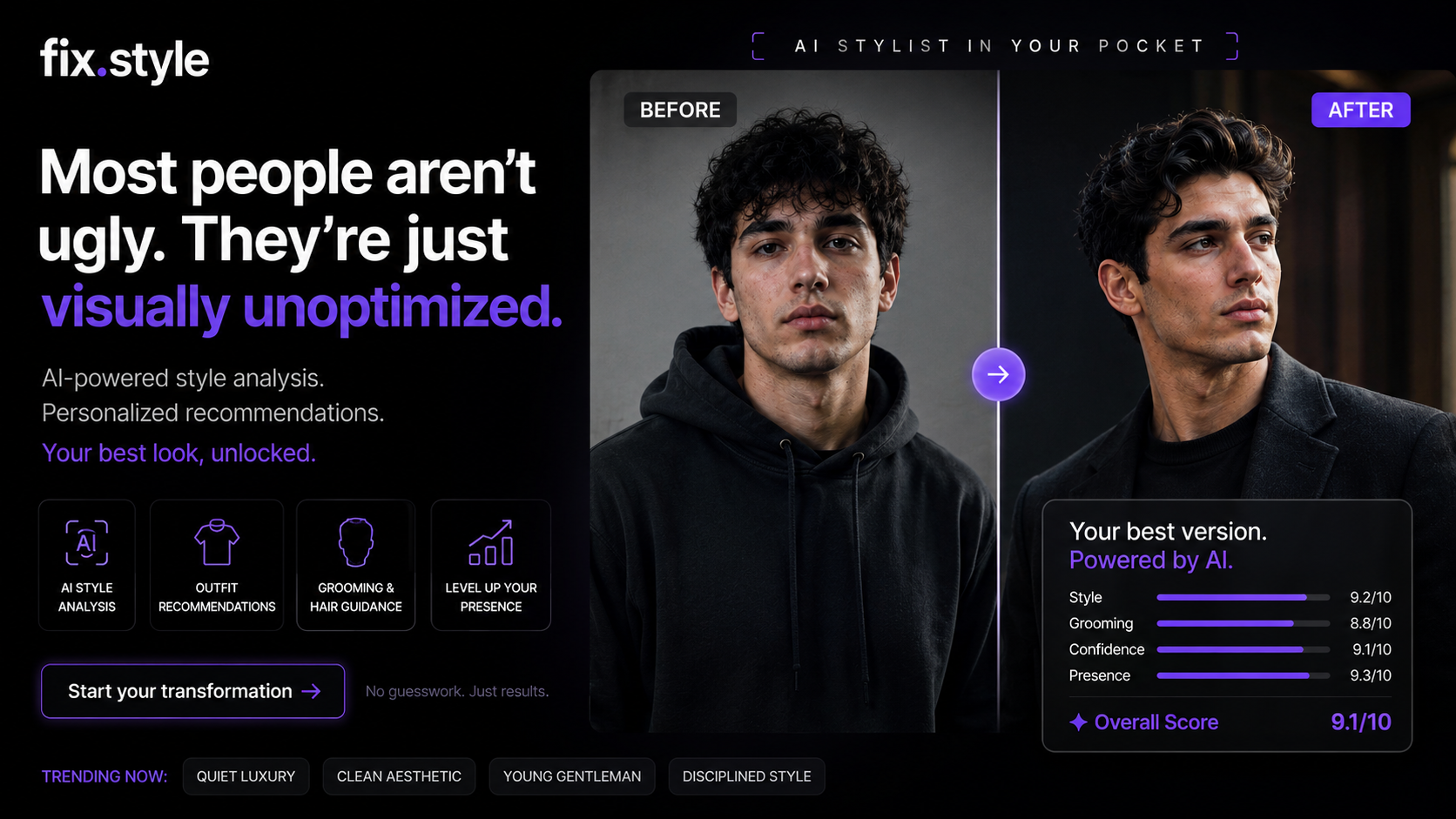
Most People Aren’t Ugly. They’re Just Visually Unoptimized.
Expensive-looking style is mostly fit, contrast, texture, grooming, and restraint.
01
The real problem
A good outfit is not a shopping problem first. It’s a visual coherence problem. Most people don’t look underdressed because their clothes are cheap. They look under-edited because the shapes, colors, grooming, and materials are arguing with each other.
Look at someone who reads expensive in a plain white T-shirt. The shirt is not magic. The sleeve hits the middle of the bicep, the collar sits close to the neck, the cotton has enough weight to hang instead of twist, and the color works with their skin. Nothing is loud, so your eye relaxes. That relaxation is what people mistake for money.
The opposite is visual noise. A jacket shoulder droops half an inch. Jeans pool over sneakers. Hair is shaped by habit instead of bone structure. The glasses are too narrow. The bag is nylon and tired. None of it is catastrophic. Together, it makes the person look unfinished.
The cheap fix is not pretending to be rich. It’s removing friction. When the line of the body is cleaner, the colors sit closer to the face, and the textures have some density, the whole person reads sharper before anyone notices a label.
02
Fit buys taste
Fit is the first tax on cheap clothing. A low-cost piece with the right proportions beats an expensive piece that fights your frame. This is why a $35 pair of trousers can look considered after a $22 hem, while a designer pair can look borrowed if the rise is wrong.
Start with the shoulder, waist, sleeve, and break. A jacket shoulder should end where your shoulder ends. Not where you wish it ended. A shirt sleeve should show wrist, not swallow the hand. Trousers should fall cleanly without a wet little puddle at the shoe. That puddle is where elegance goes to die.
For women, the same rule applies, just with more silhouette options. A blazer that nips slightly at the waist will usually read more expensive than one that hangs like a rectangle, unless the rectangle is deliberate and architectural. A skirt or trouser that hits at the most intentional part of the leg matters more than the price tag. Cropped at the wrong point, it cuts the body into awkward fractions.
Cheap tailoring is not glamorous, which is why it works. Hem trousers. Shorten sleeves. Take in a waist. Replace plastic buttons on a coat with horn-effect or matte corozo buttons. The eye reads proportion and finish long before it reads fabric composition.
- Hem trousers until fabric kisses the shoe, not collapses over it.
- Shorten sleeves so wrists and watches have room to breathe.
- Take in waists when the garment swings away from the torso.
- Replace shiny plastic buttons with matte horn-effect buttons.
- Steam knits and shirts so fabric hangs with weight.
03
Color does surgery
People trying to look expensive often reach for black because they think black is safe. Sometimes it is. Often it’s just harsh. Cheap black cotton fades into a sad charcoal after six washes, and against softer coloring it can drain the face. Expensive-looking color is usually quieter: stone, oatmeal, navy, tobacco, ivory, chocolate, olive, soft white, ink, pewter.
The mechanism is contrast. Your clothes should frame your face, not compete with it. If you have high contrast features, like dark hair and pale skin or bright eyes against deeper skin, you can carry sharper contrast: navy with white, black with cream, espresso with pale blue. If your coloring is softer, a full black and white outfit may wear you instead. Mid-tones will usually look richer: taupe with ivory, olive with ecru, heather grey with washed navy.
Monochrome works because it removes decision points. A charcoal knit with charcoal trousers and black leather loafers can look expensive even when each piece is modest. The trick is texture. If every item is the same flat cotton, it looks like a uniform bought in a hurry. Mix wool, cotton poplin, suede, denim, ribbed knit, matte leather. Same color family, different surfaces. That’s depth without shouting.
Avoid the cheap color traps: optical white polyester, neon accent panels, fake gold hardware, and thin black jersey that clings to every seam. They photograph poorly and age worse.
04
Texture carries money
Fabric is where inexpensive clothes confess. Not because affordable fabric is automatically bad, but because flimsy fabric has no manners. It twists at seams, clings at the wrong places, shines under light, and loses shape by lunch.
Choose density. Heavy cotton T-shirts, crisp poplin shirts, merino knits, cotton twill trousers, wool-blend coats, rigid or mid-weight denim, suede, matte leather. These materials hold a line. A line makes the body look intentional. Thin viscose, shiny polyester, limp jersey, and foam-like synthetic knits can work in rare cases, but they ask for more styling skill than most people want to spend on a Tuesday.
Texture is also how you make simple outfits look rich without adding logos. A ribbed tank under a brushed wool blazer. A poplin shirt with washed straight-leg denim. A suede loafer against cotton twill. A fine-gauge merino crew neck with a leather belt that has a solid buckle, not a mirror finish.
Shoes matter because they anchor the read. Clean white leather sneakers, black loafers, suede chukkas, ballet flats, low block-heel boots, simple derbies, or minimal sandals will do more for the outfit than a loud top. The shoe tells people whether the outfit was assembled or merely survived.
- Choose heavy cotton tees that hang straight from the shoulder.
- Wear merino knitwear when acrylic starts pilling at the cuffs.
- Pick rigid denim when stretch denim bags out by afternoon.
- Use suede shoes to soften outfits without losing polish.
- Avoid shiny synthetics near the face in daylight.
05
Grooming finishes clothes
Grooming is part of style because the eye does not separate the haircut from the collar. A beautiful coat under neglected hair still looks accidental. A cheap coat with clean hair, healthy skin, and a neat neckline suddenly has a point of view.
Hair should create architecture around the face. For men, that might mean taking weight off the sides, cleaning the neckline every two weeks, and using a matte clay instead of wet gel. Wet shine can make hair look thinner and more frantic. Matte texture reads calmer. For women, it might mean cutting dead length, adding face-framing pieces that relate to cheekbones, or choosing a blowout shape that supports the jaw rather than hiding it.
Skin does not need to be perfect. It needs to look cared for. A gentle cleanser, moisturizer, and daily SPF will beat a cabinet of panic products. The reason is surface quality. When skin is calmer, clothes look more expensive because the entire presentation has less static.
Accessories sit in the same category. Glasses should match face width. Jewelry should look chosen, not accumulated. A thin chain, small hoops, a signet ring, a good watch, a leather belt with a quiet buckle. One or two points of metal are enough. More can work, but only when it’s styled with discipline.
06
Spend with bias
Looking expensive for cheap is mostly editing. The affordable wardrobe that works is smaller than people want and better repeated than people expect. You need a few reliable shapes in good colors, then you rotate texture and proportion.
Build around a base uniform. For many men, that’s straight dark denim or wool trousers, a heavy tee or oxford shirt, a merino knit, a chore jacket or soft blazer, and clean leather shoes. For many women, it might be straight-leg trousers, a column skirt, ribbed knits, a sharp shirt, a long coat, and low-profile shoes with a defined shape. The exact pieces change with body, climate, and taste. The principle doesn’t.
Spend where wear shows. Shoes, coats, bags, glasses, and knits expose quality fastest. Save on simple tees, shirts, and trousers if the fit is good and the fabric behaves. A plain Uniqlo U tee in the right size can look better than a luxury tee with a stretched collar. COS, Arket, Massimo Dutti, Muji, Everlane, Mango, Weekday, Levi’s, and vintage wool coats can all do serious work when chosen with a ruthless eye.
Do not chase the outfit. Chase the repeatable silhouette. Once your best trouser rise, neckline, jacket length, shoe shape, and color range are known, shopping gets quieter. Quieter is usually where the money is.
- Spend on shoes because worn soles age the whole outfit.
- Spend on coats because outerwear sets the first impression.
- Spend on glasses because frames redraw the face daily.
- Save on tees once you know your collar and sleeve fit.
- Save on shirts if the collar sits cleanly under jackets.
07
Your style map
Fix Style is built for exactly this kind of visual optimization. You upload photos, and the system reads your proportions, coloring, grooming signals, wardrobe gaps, and current style friction, then turns that into a 14-section senior-stylist strategy report with portraits of your upgraded direction and a practical wardrobe brief. Not fantasy shopping. A better read of what already makes you look expensive, what’s making you look cheaper than you are, and what to change first.